College of Food Science, Southwest University
China-Hungary Belt and Road Joint Laboratory on Food Science



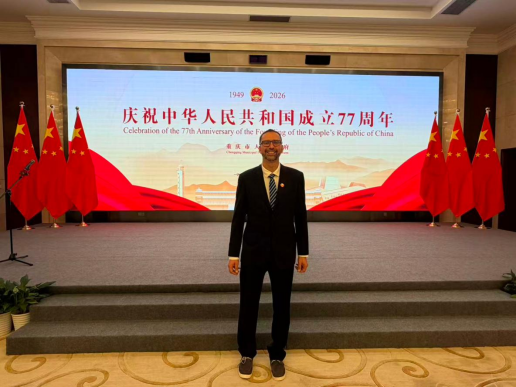
Recently, Dr. András Nagy, Senior Researcher at the Hungarian University of Agriculture and Life Sciences, attended the reception held by the Chongqing Municipal People's Government to celebrate the 77th anniversary of the founding of the People's Republic of China, as a foreign cooperation expert of the China–Hungary Belt and Road Joint Laboratory on Food Science (preparation) (hereinafter referred to as the "Belt and Road" Joint Laboratory). At the event, Dr. András Nagy gained a close-up understanding of China's economic and social development achievements and the cultural character of the city of Chongqing. This participation further deepened the friendship between Chinese and Hungarian researchers, creating a positive and favorable atmosphere for international cooperation in the field of food science between the two countries under the framework of the "Belt and Road" Initiative.
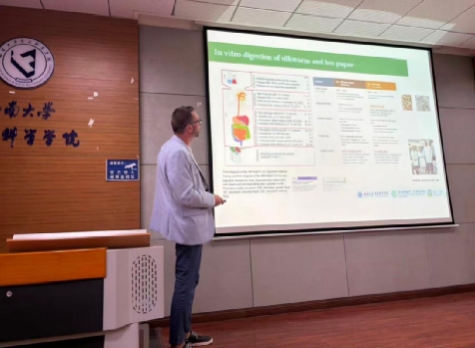
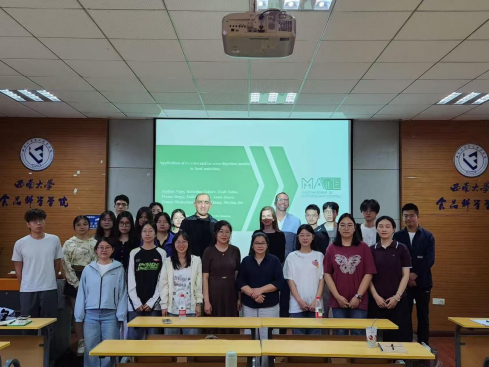
It is learned that Senior Researcher András Nagy, funded by a project under the Strategic Science and Technology Innovation Cooperation Program of the National Key Research and Development Program, visited Southwest University to deliver a series of academic lectures and carry out research cooperation. During the joint research at the "Belt and Road" Joint Laboratory, Dr. András Nagy conducted a series of training sessions for graduate students on the application of in vitro and in vivo digestion models in food nutrition. He systematically reviewed the INFOGEST in vitro static digestion model, the TIM-1/TIM-2 dynamic digestion systems, and in vivo digestion models in animals such as pigs and rats, comparing the advantages and limitations of the various models in simulating the human gastrointestinal digestion process. Meanwhile, he shared several cutting-edge research findings, including the binding stability of lactic acid bacteria to aflatoxin B1, the influence of the food matrix on toxin bioavailability, and the impact of meat cooking conditions on the postprandial plasma peptidome. The two sides also held discussions on the practical application of New Approach Methodologies (NAMs) in food nutrition evaluation, the release of functional factors, and food safety risk assessment. In the future, sustained cooperation will be carried out in the field of big health, covering the development of insect protein resources, the substitution of NAMs models, and green food biomanufacturing.
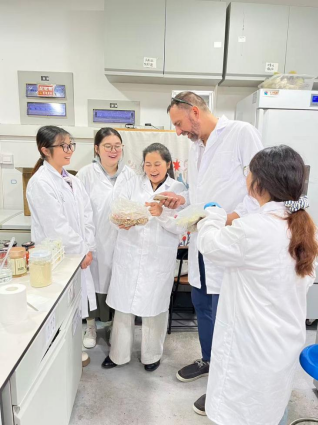
In addition, Dr. András Nagy went deep into the laboratories of the College of Food Science at Southwest University to provide hands-on guidance for graduate students on experiments related to in vitro digestion. During the exchange, the college's research team presented Dr. András Nagy with a batch of specialty foods and experimental samples, including bee pupae, silkworm pupae, chili sauce, and honey. He asked in detail about the raw material sources, processing techniques, fermentation conditions, and quality characteristics of each sample. The two sides fully exchanged views on such directions as the development of insect protein resources, the mining of microorganisms in traditional fermented foods, and the functional evaluation of bee products, and both agreed that there is a bright prospect for cooperation between China and Hungary in the development of specialty food resources and national big health.
This series of foreign-affairs academic exchanges has built an efficient dialogue platform in the field of food science between China and Hungary, promoting the exchange of ideas and mutual learning of technologies among researchers of the two countries and laying a solid foundation for future joint scientific research and two-way personnel visits. As a next step, the China–Hungary "Belt and Road" Joint Laboratory for Food Science (in preparation) and the College of Food Science at Southwest University will continue to deepen international cooperation and, by leveraging the opportunities of the "Belt and Road" Initiative, help drive research innovation in food science and the big health industry.
Contributor: Du Muying
Initial Review: Hu Zi
Second Review: Yao Shixiang
Final Review: Zhang Binjia